
Power Quality Problems in Nepal’s Industries
Introduction
In many industrial facilities in Nepal, electrical problems are often blamed on equipment faults or poor machinery design. However, a significant number of failures are actually caused by poor power quality.Modern factories use large numbers of electronic loads such as variable frequency drives (VFDs), UPS systems, solar inverters, switching power supplies, and automation equipment. These devices interact with the electrical network in ways that can distort voltage and current waveforms.
When power quality deteriorates, equipment may experience unexpected trips, overheating, communication failures, or reduced lifespan. Identifying and diagnosing these issues requires proper measurement and analysis of electrical parameters.
What is Power Quality?
Power quality describes how stable and clean the electrical supply is. In an ideal system:
- voltage remains close to its rated value
- frequency remains stable
- three-phase voltages remain balanced
- current waveforms are close to sinusoidal
When any of these conditions deviate significantly, the electrical supply can begin affecting equipment performance.
Common Power Quality Problems in Industrial Facilities
Harmonic Distortion
Harmonics are one of the most common power quality issues in modern industrial systems.
They are caused by non-linear loads, such as:
- variable frequency drives (VFDs)
- UPS systems
- solar inverters
- LED lighting systems
- computer power supplies
These devices draw current in pulses rather than smooth sinusoidal waves, which introduces additional frequency components into the electrical system.
Excessive harmonics can cause:
- overheating of transformers
- overheating of neutral conductors
- malfunction of protection devices
- reduced efficiency of motors
In severe cases, harmonic distortion can damage electrical equipment.
Voltage Fluctuations
Voltage fluctuations occur when the supply voltage rises or drops outside acceptable limits.
Common causes in industrial environments include:
- large motor starting currents
- welding machines
- heavy load switching
- weak distribution networks
Voltage dips can cause equipment such as PLCs, drives, and control systems to trip or reset unexpectedly.
Voltage Imbalance
Voltage imbalance occurs when the three phases do not maintain equal voltage levels. Even small imbalances can cause serious issues in three-phase motors.
A voltage imbalance of only a few percent can lead to:
- increased motor heating
- reduced motor efficiency
- higher current draw
- premature insulation failure
Maintaining balanced loads across phases is important for system stability.
Transient Overvoltages
Electrical transients are short-duration voltage spikes.
They can be caused by:
- lightning strikes
- switching of capacitor banks
- switching of inductive loads
- grid disturbances
Sensitive electronic equipment can be damaged by repeated transient events.
Why Power Quality Problems Matter
Poor power quality affects both reliability and operational costs.
Industrial facilities may experience:
- unexplained equipment trips
- frequent inverter or drive faults
- overheating cables or transformers
- reduced equipment life
- production downtime
Without proper analysis, these problems may persist for years while operators attempt to fix symptoms rather than the root cause.
Measuring Power Quality in Industrial Systems
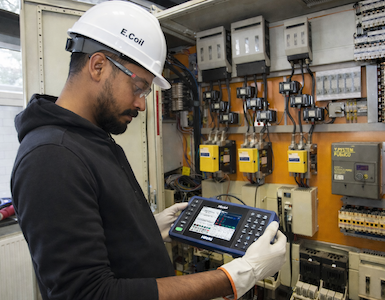
Power quality problems cannot usually be diagnosed using simple measurement tools. Basic multimeters measure only voltage, current, and resistance. They cannot detect harmonic distortion, waveform distortion, or transient events. To properly analyze power quality, engineers use power quality analyzers capable of recording electrical parameters over time.
These instruments typically measure:
- voltage and current waveforms
- harmonic distortion levels
- power factor
- voltage imbalance
- frequency variation
- transient events
- energy consumption trends
Power quality analyzers can record data continuously over several hours or days, allowing engineers to identify disturbances that occur during specific operating conditions.
Diagnosing the Root Cause
Once power quality data is collected, engineers analyze the waveform data and event logs to identify the source of disturbances.
Examples include:
-
high harmonic distortion caused by large VFD installations
-
voltage dips caused by heavy motor starting
-
phase imbalance due to uneven load distribution
-
transient spikes caused by switching events
Understanding the source of the problem is essential before implementing corrective solutions.
Technical Solutions for Power Quality Problems
Several engineering solutions can improve power quality depending on the type of disturbance.
Possible solutions include:
- installation of harmonic filters
- proper load balancing across phases
- upgrading transformers or cables where required
- installing surge protection devices
- improving earthing systems
- optimizing power factor correction systems
Each solution should be selected based on measurement data and system analysis.
Conclusion
Power quality problems are increasingly common in industrial electrical systems due to the growing use of electronic loads and automation equipment. Voltage disturbances, harmonic distortion, and transient events can significantly affect equipment performance and reliability.
Accurate measurement using professional power quality analyzers allows engineers to diagnose these issues and implement effective corrective measures. Proper monitoring and analysis of electrical systems help industries maintain reliable operation and prevent costly equipment failures