
Surge Protection Devices (SPD) in Solar and Industrial Systems
Introduction
If you have been working in solar or industrial electrical installations for any length of time, you already know that the equipment you are protecting is not cheap. Inverters, PLCs, SCADA systems, control panels, instrumentation — these represent serious investment. And yet, one of the most overlooked parts of protecting all of it is something as straightforward as a Surge Protection Device.
Transient overvoltages are a real and constant threat. They come from lightning strikes, grid switching events, capacitor bank operations, transformer energization, and inductive load switching. Most of them last only microseconds. But in that tiny window, they can break down insulation, destroy sensitive electronics, corrupt data, and take an entire system offline.
SPDs are designed to catch those events before they cause damage, diverting the surge current safely to earth while the rest of the system keeps running. The catch is that a poorly selected or incorrectly installed SPD can be almost as bad as having none at all. That is what this article is about.
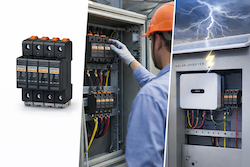
What Does an SPD Actually Do?
At its core, a Surge Protection Device sits quietly in your electrical system doing nothing until it needs to act. Under normal conditions, it presents a high impedance to the circuit. The moment a transient pushes voltage above the defined protection level, it switches to low impedance, provides a path for the surge current to flow to earth, and then returns to its standby state once the event is over.
This happens in nanoseconds. The protected equipment downstream either sees nothing at all, or sees a voltage that has been clamped to a safe level. Done right, the whole event passes without any damage or downtime.
The sources of these surges are more varied than most people realise. Yes, lightning is the obvious one, but switching surges from motors and contactors, capacitor bank operations, electromagnetic coupling, and grid disturbances all generate transients that can travel through your wiring and damage equipment without any storm in sight.
The Standards That Guide SPD Selection
Before getting into product selection, it is worth knowing which standards govern this area. Getting SPD design right means working within these frameworks.
IEC 61643-11 covers requirements and test methods for low voltage surge protective devices. This is your primary reference for most LV installations.
IEC 62305 is the series that deals with protection against lightning more broadly, from risk assessment through to full system design. If you are working on a solar farm or a large industrial site, a lightning risk assessment per IEC 62305-2 should come before SPD selection, not after.
IEC 60364-4-44 addresses protection against voltage disturbances and electromagnetic disturbances in electrical installations.
IEC 60364-5-53 covers the selection and erection of protective devices, including SPDs, within electrical installations.
These are not just bureaucratic checkboxes. They represent accumulated engineering knowledge of what actually works in the field, and they exist because the consequences of getting this wrong are expensive.
The Three Types of SPD and Where They Belong
SPDs are broadly classified into three types. Each type is designed for a specific location in the system and a specific level of surge energy.
Type 1 — Lightning Current Arrester
Type 1 SPDs are built for high energy events. They are tested using a 10/350 µs impulse waveform, which simulates the kind of current that flows from a direct lightning strike. These devices go at the main service entrance, and they are mandatory wherever the building or facility has an external lightning protection system with air termination rods or conductors.
If a site has a lightning protection system installed and no Type 1 SPD at the main panel, the lightning protection is essentially incomplete. The current will find a path into the building's electrical system regardless.
Typical installations include industrial plants, telecom towers, solar farms with dedicated lightning protection, and large commercial buildings.
Type 2 — Surge Arrester
Type 2 is the workhorse of surge protection. Tested with an 8/20 µs waveform and offering medium discharge capacity, these devices handle the indirect lightning surges and switching transients that make up the vast majority of real world events. They are installed at sub-distribution boards and are the most commonly deployed SPD type in both solar and industrial systems.
You will find Type 2 SPDs at inverter AC distribution panels, main LT panels, industrial control panels, and throughout commercial building distribution systems.
Type 3 — Equipment Level Protection
Type 3 SPDs are the last line of defence. They have low discharge capacity but a very low protection voltage level, making them suitable for installation right at sensitive equipment such as PLCs, SCADA systems, instrumentation panels, and communication devices. They are not designed to handle large surge events on their own. They work together with Type 1 and Type 2 devices installed upstream.
SPD in Solar PV Systems
Solar installations deserve their own discussion because the risk profile is genuinely different from a standard industrial facility.
PV arrays are installed outdoors, on rooftops, on open ground, and on carport structures, in direct exposure to lightning activity. The DC cable runs between the array and the inverter can stretch for significant distances, and long cables in open environments are very effective at picking up induced surges from nearby lightning events, even when there is no direct strike anywhere near the site.
The inverters at the heart of these systems contain sophisticated power electronics including MPPT circuitry, grid synchronisation components, and communication modules, all of which have limited tolerance for overvoltage. A surge that the inverter survives today can cause latent damage that shows up as an unexplained failure six months later.
On top of that, grid tied systems are connected to the utility network, meaning surges can arrive from the grid side just as easily as from the PV array side.
SPD placement in a PV system needs to cover three areas. On the DC side, protection is needed between the PV array and the inverter input at the combiner box or string box level. On the AC side, protection is needed at the inverter output distribution panel. And where remote monitoring or communication systems are in use, signal line SPDs on RS485 and Ethernet connections should also be considered.
One important point worth noting is that DC rated SPDs are not interchangeable with AC rated devices. DC circuits cannot interrupt arcs the way AC circuits can, so using an AC rated SPD on a DC circuit is a genuine fire risk, not just a performance issue.
The Parameters That Actually Matter When Selecting an SPD
Walking into a supplier and asking for a surge protector is not enough. These are the numbers that determine whether the device you install will actually protect your system.
Maximum Continuous Operating Voltage (Uc) is the most critical parameter to get right. The SPD must be rated for the maximum voltage it will see continuously in normal operation. For AC systems, this means accounting for supply voltage tolerances. For PV DC systems, Uc must be based on the maximum open circuit voltage of the string under cold temperature conditions, which is often considerably higher than the nominal system voltage. Undersizing Uc is one of the most common causes of premature SPD failure in solar installations.
Nominal Discharge Current (In) tells you how much surge current the device can handle repeatedly over its service life. Higher In ratings generally mean a more durable device in environments with frequent transient activity.
Maximum Discharge Current (Imax) is the peak current the device can withstand during a worst case single event without failing. This is the number to focus on when assessing risk in lightning prone areas.
Voltage Protection Level (Up) is what reaches your equipment after the SPD has clamped the surge. Lower is better. Always check that the Up of your chosen SPD is below the impulse withstand voltage of the equipment you are protecting, otherwise the device is technically functioning but the equipment is still being damaged.
Response Time matters because surges rise extremely fast. SPDs need to respond in nanoseconds, and the connection lead length between the SPD and the busbar affects this in practice. Keep leads as short as possible.
Earthing — The Part People Underestimate
An SPD diverts surge current to earth. If the earthing system is poor, the surge current has nowhere to go effectively, and the protection level at the equipment terminals will be much higher than the SPD's rated Up value suggests.
Low earth resistance, proper bonding of all metallic structures, short and direct connections between the SPD and the earth bar, no sharp bends in earthing conductors, and proper equipotential bonding across the whole system, all of these directly affect how well your SPDs actually perform.
This is not a secondary consideration. A well selected SPD installed into a poor earthing system will underperform in exactly the moments it matters most.
Why Coordination Between SPD Types Matters
When you install Type 1, Type 2, and Type 3 SPDs in the same system, which you should for any serious installation, they need to work together in a coordinated way. The principle is straightforward. Each stage absorbs and limits the surge energy progressively, so that by the time it reaches the sensitive equipment it has been reduced to a safe level.
Without coordination, the downstream device ends up absorbing more energy than it was designed for. It may survive the first event. It may survive several. But each event degrades it silently, and one day it fails in a way that leaves the equipment completely unprotected.
Manufacturers often specify minimum separation distances between SPD types or recommend specific coordination pairs. Following these recommendations is not overkill. It is how the protection system actually works as intended.
What Goes Wrong in Real Installations
Field experience across solar and industrial sites consistently shows the same failure patterns. The wrong voltage rating on the Uc. No DC side protection at all in PV systems because the installer focused only on the AC panel. Type 1 and Type 2 devices installed without any coordination between them. Earthing connections made with long, looping conductors that add impedance and reduce effectiveness. And perhaps most frustratingly, no status indicator or monitoring on the SPD, so when it fails silently after absorbing a large event, nobody knows the system is now unprotected.
Each of these is avoidable with proper design and specification upfront.
Conclusion
Surge protection does not get the attention it deserves until something goes wrong. And by then the conversation has shifted from prevention to replacement costs, downtime, and figuring out what failed and why.
A properly selected and installed SPD system, sized to the right voltage, coordinated across protection stages, and backed by solid earthing, is one of the most reliable investments you can make in the long term performance of a solar or industrial installation. The cost of getting it right is a fraction of the cost of getting it wrong.
If you are designing a new system or reviewing an existing installation, the time to think about surge protection is before the next storm season, not after.
For technical assistance with SPD selection for your solar or industrial project, reach out to our team. We supply IEC compliant surge protection devices for DC and AC applications across residential, commercial, and industrial installations.